
Many engineers know their projects well but still struggle when writing CDR report content that meets Engineers Australia’s expectations. They often describe team duties, skip technical decisions, or choose projects that do not show enough personal engineering work.
A better approach starts with clear planning, suitable project selection, and strong proof of what you personally did. Each section should show your actions, reasoning, technical methods, and results in a simple order.
In this guide, you will learn how to write CDR report content in a clear order, from selecting projects to checking the finished document. You will also learn what to include and which mistakes to avoid before submission.
Highlights
- A strong CDR starts with suitable projects that clearly show your personal engineering work, technical tasks, decisions, and results.
- Each Career Episode should follow a clear format with an introduction, background, personal engineering activity, and summary.
- Write in the first person, explain your methods, and support your claims with accurate calculations, standards, software, tests, or project records.
- Before submission, check paragraph numbering, competency references, dates, job titles, technical details, originality, and overall consistency.
What is a CDR Report?
A Competency Demonstration Report (CDR) is a written submission used by Engineers Australia (EA) to assess an applicant’s engineering knowledge, skills, and work experience. It shows whether the applicant meets the competency standard for their nominated engineering occupation.
The report presents real engineering projects and explains what the applicant personally did. It should show technical analysis, calculations, design work, problem-solving, decisions, and project results rather than only listing job duties.
Who Needs to Prepare a CDR?
The CDR pathway usually applies when Engineers Australia cannot assess your qualification through an accredited qualification pathway. It happens when your course does not fall under a recognised international accord or when your qualification does not match an accepted accredited program.
You typically need a CDR if:
- Your engineering degree is from a country or institution not covered by EA’s recognition agreements
- Your qualification does not exactly match an EA-accredited program
- EA specifically asks for one as part of your skills assessment pathway
What Are the Main Components of a CDR Report?
Your CDR report has three main components: a Continuing Professional Development (CPD) list, three Career Episodes, and a Summary Statement. Together, they give Engineers Australia a full picture of your qualifications, ongoing learning, and hands-on engineering experience.
I. Continuing Professional Development (CPD)
Your CPD record shows EA that you have kept learning since you graduated. It is usually a one-to-two-page list covering the period from your graduation to your application date.
It should include:
- Post-graduate study, short courses, or certifications
- Conferences, seminars, or workshops attended
- Professional memberships or industry group involvement
- On-the-job training or mentoring activities
Note: EA expects CPD entries listed in chronological order, with accurate dates for each activity.
II. Three Career Episodes
Career episodes are personal accounts of your engineering work, written as three separate reports. Each one should focus on a different project, role, or period in your career so that, together, they show a range of skills.
A career episode is usually built around four parts:
- Introduction – states the project, dates, location, and your role
- Background – explains the project context and objectives
- Personal Engineering Activity – describes what you personally did and how you solved technical problems
- Summary – wraps up the outcome and your contribution
III. Summary Statement
The summary statement links specific paragraphs from your three career episodes to each competency element EA requires for your occupation category. It does not introduce new information; its only job is to cross-reference your existing career episode content against EA’s competency indicators.
What Should You Do Before You Start Writing Your CDR?
Before you start writing your CDR, confirm your assessment pathway, engineering category, and nominated occupation with Engineers Australia. Then collect your academic records, employment details, project documents, competency standards, and evidence of your personal engineering work.
1. Confirm Your Assessment Pathway
Check whether the CDR pathway applies to your qualification. You should also confirm your nominated engineering occupation and occupational category because these determine the competency standard used for assessment.
2. Read the Current Guidelines
Use the latest Migration Skills Assessment guide and Career Episode instructions from Engineers Australia. Requirements and templates may change, so avoid relying only on old samples or third-party advice.
3. Collect Your Records
Gather your academic certificates, transcripts, employment records, CV, project reports, drawings, calculations, and other documents related to your engineering work. These records will help you write accurate project details.
4. Check Important Details
Confirm project dates, locations, organisation names, job titles, and employment periods before you begin. These details should remain consistent throughout your CDR and supporting documents.
5. List Possible Projects
Prepare a list of academic or workplace projects that involved real engineering work. Note your role, technical tasks, problems handled, decisions made, and results for each project before choosing the strongest examples.
How to Choose Projects for Your CDR?
When choosing projects for your CDR, select three projects that show how you applied engineering knowledge and what you personally contributed. Each of them should give you enough material to explain your role, technical methods, decisions, problems, and results.
- Match Your Nominated Occupation: Select projects related to the engineering occupation named in your application. The technical work should reflect the tasks and skills expected in that field.
- Show Your Personal Engineering Work: Choose projects where you completed identifiable engineering tasks. You should be able to explain what you designed, calculated, tested, analysed, checked, or improved.
- Include Enough Technical Detail: A strong project gives you space to discuss engineering methods, software, standards, calculations, drawings, or testing procedures. Avoid projects based mainly on administration or routine supervision.
- Choose Projects with Real Problems: Select work where you identified and solved an engineering issue. Explain how you found the cause, compared possible solutions, and checked the final result.
- Use Projects with Supporting Records: Pick projects for which you still have accurate dates, reports, drawings, calculations, or other records. These details help you write factual and consistent Career Episodes.
- Show Different Engineering Skills: Your three projects should not repeat the same tasks and examples. Use them to show a wider range of technical work, problem-solving, teamwork, communication, and project responsibilities.
- Choose Projects You Understand Well: Select work that you can explain confidently in your own words. Do not choose a project only because it sounds impressive when your role in it was small or unclear.
How to Write a CDR Report Step by Step
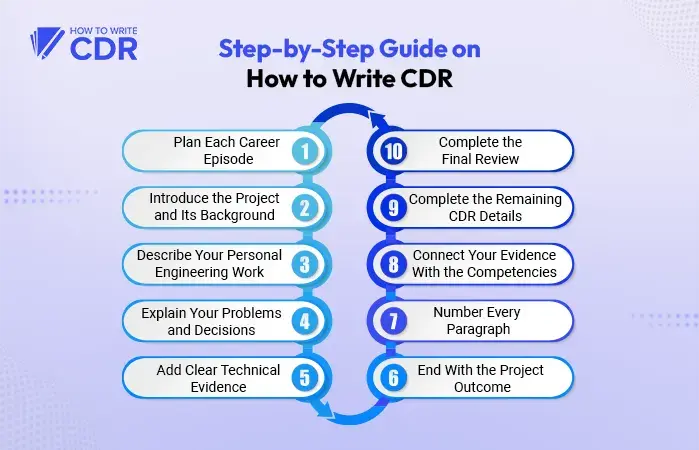
To write a CDR report, organise your project facts first and then build each Career Episode around your personal engineering work. Once the episodes are complete, number the paragraphs, map the competency evidence, add your CPD record, and review the full document for accuracy.
Step 1: Plan Each Career Episode
Before writing, prepare notes for the project title, dates, location, organisation, position, objective, responsibilities, technical tasks, problems, and results. Check these details against your academic or employment records so your information remains consistent throughout the application.
Step 2: Introduce the Project and Its Background
Start each Career Episode by identifying when and where the project took place, the organisation involved, and the position you held. Then explain the project objective, your work area, the team structure, and your assigned responsibilities without adding a long history of the company or project.
Step 3: Describe Your Personal Engineering Work
Use most of the Career Episode to explain what you personally completed and how you completed it. Write in the first person and discuss your calculations, designs, technical methods, software, standards, tests, and checks instead of writing broad statements about what your team did.
Step 4: Explain Your Problems and Decisions
Describe the engineering problems you faced and take the reader through your response in a clear order. Explain how you identified the cause, which options you considered, why you selected a method, how you applied it, and how you checked whether it worked.
Step 5: Add Clear Technical Evidence
Support your explanation with technical details such as design values, formulas, drawings, test results, standards, or performance comparisons where they help the reader understand your work. Always explain what the evidence shows and how you used it, because tables and diagrams alone do not show your personal contribution.
Step 6: End With the Project Outcome
Close each Career Episode by stating whether the project met its objectives and how your work affected the final result. Briefly mention your main contribution and what you learned, but do not introduce a new problem or technical process in the closing paragraph
Step 7: Number Every Paragraph
Give each paragraph a clear number so you can refer to it later. Use 1.1, 1.2, and 1.3 for Career Episode 1, then follow the same pattern with 2.1 for Career Episode 2 and 3.1 for Career Episode 3.
Step 8: Connect Your Evidence With the Competencies
After completing all three episodes, review them against the competency elements for your occupational category. Add the exact paragraph references to the Summary Statement and make sure each cited paragraph clearly shows the skill you are claiming.
Step 9: Complete the Remaining CDR Details
Finish the CDR by checking your CPD record, Summary Statement, project information, and supporting documents together. Confirm that names, dates, positions, project titles, and employment periods match across every part before moving to the final CDR report review.
Step 10: Complete the Final Review
Read each episode once for technical content and once for presentation. Check grammar, paragraph flow, numbering, labels, attachments, and file names. Open every final file before upload. Make sure no pages are missing, and every Summary Statement reference leads to the right paragraph.
What Is the Correct Career Episode Format?
A clear Career Episode format normally moves through four parts: introduction, background, personal engineering activity, and summary. Each episode must focus on your own engineering work and use numbered paragraphs so the evidence can be linked to the required competencies.
Introduction
Start with the basic details that identify the engineering project or activity. Include the project title, dates, location, organisation, and the position you held so the assessor can understand where and when the work took place.
Background
Give enough context to explain the project’s purpose, scope, and working environment. You may include the project objectives, team structure, your reporting position, and the responsibilities assigned to you, but avoid adding a long company history.
Personal Engineering Activity
This is the main part of the episode. Describe your technical work, decisions, calculations, methods, designs, difficulties, and results. Write this section in the first person with statements such as “I calculated,” “I designed,” and “I tested.” This makes your personal contribution clear instead of presenting the project as general teamwork.
Summary
End the episode with a brief account of the project outcome and your contribution. State whether the objectives were achieved, what engineering skills you applied, and what you learned without repeating the full project story.
Common Mistakes to Avoid When Writing a CDR Report
A weak CDR often comes from unclear project details, limited technical evidence, or too much focus on team duties. Avoiding these mistakes helps you present your own engineering work clearly and believably.
- Choosing Weak Projects: Do not select projects that involve mostly routine tasks, administration, or observation. Choose work that lets you explain technical decisions, calculations, testing, design, or problem-solving.
- Writing About the Team Instead of Yourself: Statements such as “we designed” or “we solved” make your role unclear. Use first-person language to show what you personally completed.
- Listing Duties Without Explaining Actions: A list of responsibilities does not prove how you applied engineering knowledge. Explain what you did, how you did it, and why you selected that method.
- Leaving Out Technical Details: General statements make it hard to understand your engineering ability. Add relevant calculations, standards, software, testing methods, design values, or performance results.
- Giving Results Without Explaining the Process: Do not jump from a problem to a successful outcome. Show how you found the cause, compared options, selected a solution, and checked the result.
- Repeating the Same Work in Every Episode: Three similar projects show only a narrow set of skills. Select examples that cover different tasks, problems, responsibilities, and engineering methods.
- Adding Too Much Project Background: Long company descriptions and general project history take space away from your own work. Give only the context needed to understand your role and technical activities.
- Using Incorrect Paragraph Numbers: Wrong references make competency evidence difficult to locate. Check that every number in the Summary Statement points to the correct Career Episode paragraph.
- Using Conflicting Information: Project dates, job titles, locations, and employer names should match your CV and supporting records. Review every document together before submission.
- Copying Sample Content: Samples help you understand structure, but their wording and examples should not appear in your report. Write from your own education, projects, and engineering experience.
- Submitting Without a Final Review: Small errors can weaken an otherwise clear report. Check grammar, paragraph numbering, technical facts, competency coverage, and document consistency before you submit.
FAQs
Can I write a CDR report myself?
Yes, you can write your own CDR report. In fact, Engineers Australia requires the submission to reflect your own engineering experience, actions, and technical knowledge rather than work created or copied from another person.
How long should each Career Episode be?
Each Career Episode should contain between 1,000 and 2,500 words under the current Engineers Australia writing guide. Focus most of the content on your engineering activities rather than the company background or general project description.
Can a fresh graduate write a CDR without work experience?
Yes, a recent graduate can use suitable academic projects when professional experience is limited. However, your selected project must still show how you personally applied engineering knowledge, solved problems, and made technical decisions.
Can I use AI tools to prepare my CDR?
You cannot use AI tools to prepare a CDR report because Engineers Australia requires original work and treats another person’s work presented as your own as plagiarism. You can use a tool to check grammar or organise your notes, but the technical content must remain your own.
Do I need evidence for projects used in my Career Episodes?
Yes, you need evidence for projects used in your Career Episodes to match your selected occupation with work records. Keep project reports, employer references, calculations, drawings, contracts, or other records that can support the dates, role, and engineering work described in your CDR.
What happens if Engineers Australia finds copied content in a CDR?
If Engineers Australia finds copied or plagiarized content in a CDR, it may reject the application and impose a reapplication ban of 12 to 36 months. The case may also be recorded as ethical misconduct, which can affect future assessments.
