
Many aspiring engineers and graduates in Australia and overseas find it difficult to choose the right engineering field due to the wide range of specialisations available. Without clear guidance, they often struggle to understand which disciplines offer strong job opportunities, good salaries, and migration pathways.
This confusion can lead to poor career decisions, such as selecting fields with limited demand or low long-term growth. As a result, individuals may face difficulty in securing jobs, meeting skilled migration requirements, or achieving stable career progression in Australia’s competitive engineering market.
This guide highlights the most in-demand engineering occupations, including their demand levels, average salaries, ANZSCO codes, and key factors to consider before choosing your engineering specialisation.
Why is Engineering in Demand in Australia?
Engineering is in high demand in Australia due to technological advancement, population growth, and workforce shortages across multiple engineering disciplines.
1. Engineering Skills Shortages: Many industries across Australia are facing a shortage of qualified engineering professionals. Retiring workers, growing project demands, and a limited local talent pool have created strong job opportunities for skilled engineers across different sectors.
2. Growing Population: Australia’s growing population increases the need for housing, transport, energy, water, and public infrastructure, creating strong demand for skilled engineers.
3. Technological Advancements: Automation, AI, robotics, and smart infrastructure are transforming industries, creating demand for engineers to design, implement, and maintain advanced systems.
4. Regional Development Projects: Many regional areas in Australia are experiencing growth through infrastructure, energy, agriculture, and mining projects. These developments create additional opportunities for engineers willing to work outside major cities.
5. Skilled Migration Opportunities: Engineering occupations are regularly included on Australia’s skilled occupation lists, creating migration pathways for qualified international engineers seeking long-term career opportunities and permanent residency options.
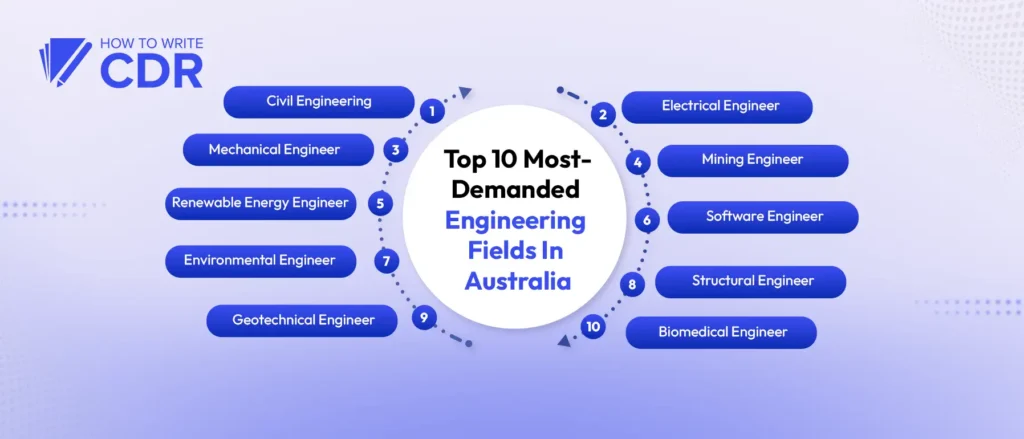
Top 10 Most-Demanded Engineering Fields in Australia
The top 10 demanding engineering fields in Australia include civil, electrical, mechanical, software, mining, environmental, structural, geotechnical, renewable energy, and biomedical engineering.
Civil Engineering
Civil engineering is one of the most important engineering fields in Australia, supporting the development of essential infrastructure. Civil engineers design and manage roads, bridges, buildings, drainage systems, water networks, and transport projects. Their work helps improve public safety, urban development, and the overall quality of life across the country.
Requirements to get a Civil Engineer job:
- Complete a bachelor’s degree in Civil Engineering or a related field.
- Get your qualification assessed by Engineers Australia if required.
- Gain practical experience through internships, graduate roles, or entry-level site work.
- Learn tools such as AutoCAD, Civil 3D, Revit, and structural or civil design software.
Average Salary:
- Graduate: $70,000 – $85,000
- Mid-level: $95,000 – $115,000
- Senior: $120,000+
Electrical Engineer
Electrical engineering is a highly demanded field in Australia, supporting power generation, renewable energy, automation, communication systems, and smart infrastructure. Electrical engineers design, test, install, and maintain electrical systems used in homes, businesses, industries, and large-scale energy projects. Their work helps improve energy efficiency, safety, and reliable power supply across the country.
Requirements to get an Electrical Engineer job:
- Study a bachelor’s in Electrical Engineering or a related field.
- Get your qualification assessed by Engineers Australia if required.
- Gain practical experience through internships, graduate programs, or entry-level engineering roles.
- Understand Australian electrical standards, safety codes, and design requirements.
- Learn tools such as AutoCAD Electrical, MATLAB, ETAP, PowerCAD, or similar electrical design software.
Salary:
- Graduate: $70,000 – $85,000
- Mid-level: $105,000 – $125,000
- Senior: $130,000+
Mechanical Engineer
Mechanical engineering supports mining, manufacturing, construction, transport, energy, and industrial operations. Mechanical engineers design, develop, test, and maintain machines, equipment, engines, and mechanical processes. Their work helps improve performance, safety, productivity, and reliability across different industries.
Requirements to get a Mechanical Engineer job:
- Complete a bachelor’s degree in Mechanical Engineering or a related field.
- Get your qualification assessed by Engineers Australia if required.
- Gain practical experience through internships, graduate programs, or entry-level engineering roles.
- Understand mechanical design, thermodynamics, fluid mechanics, and manufacturing processes.
- Learn tools such as AutoCAD, SolidWorks, ANSYS, Revit MEP, or MATLAB.
Salary:
- Graduate: $70,000 – $85,000
- Mid-level: $90,000 – $110,000
- Senior: $120,000+
Mining Engineer
Mining engineers work with the extraction of minerals, coal, metals, and energy resources on a large scale. Their responsibilities include planning mining operations, improving production methods, checking site safety, managing equipment use, and reducing environmental risks.
They often work on mine sites, in regional areas, or in FIFO (Fly-In Fly-Out) roles across states like Western Australia and Queensland.
Requirements to get a Mining Engineer job:
- Complete a bachelor’s degree in Mining Engineering or a related engineering field.
- Get your qualification assessed by Engineers Australia if required.
- Build knowledge of mine planning, drilling, blasting, production, and site safety.
- Gain practical experience through graduate mining programs, internships, or site-based roles.
- Learn mining software such as Surpac, Vulcan, Deswik, MineSight, or similar tools.
Salary:
- Graduate: $90,000 – $120,000
- Mid-level: $145,000 – $165,000
- Senior: $170,000+
Software Engineer
Software engineering is a fast-growing field in Australia, supporting digital transformation, cloud computing, cybersecurity, artificial intelligence, automation, and business software development. Software engineers design, build, test, and maintain applications, websites, systems, and digital platforms. Their work helps businesses improve efficiency, security, customer experience, and online operations.
Requirements to get a Software Engineer job:
- Get a bachelor’s degree in Software Engineering, Computer Science, IT, or a related field.
- Build strong programming skills in languages such as Python, Java, JavaScript, C++, or PHP.
- Gain practical experience through internships, coding projects, or entry-level developer roles.
- Understand databases, APIs, cloud platforms, cybersecurity, and software testing.
- Create a strong portfolio through GitHub projects, apps, websites, or real-world software work.
Salary:
- Graduate: $75,000 – $95,000
- Mid-level: $105,000 – $125,000
- Senior: $130,000+
Environmental Engineer
Environmental engineers focus on reducing pollution, improving water quality, managing waste, and supporting sustainable development. Their work includes designing treatment systems, preparing environmental reports, checking project compliance, and helping industries meet environmental regulations. They are commonly involved in water projects, construction planning, mining operations, government projects, and climate-resilient infrastructure.
Requirements to get an Environmental Engineer job:
- Complete a bachelor’s degree in Environmental Engineering, Civil Engineering, Chemical Engineering, or a related field.
- Get your qualification assessed by Engineers Australia if required.
- Build knowledge of environmental laws, sustainability practices, water treatment, and waste management.
- Gain experience through internships, consulting firms, government projects, or entry-level environmental roles.
- Learn tools such as GIS, AutoCAD, water modelling software, and environmental assessment tools.
Salary:
- Graduate: $70,000 – $90,000
- Mid-level: $110,000 – $130,000
- Senior: $130,000+
Structural Engineer
Structural engineers work on the strength, stability, and safety of buildings and infrastructure. They design structural elements such as beams, columns, slabs, foundations, bridges, and retaining walls. Their work helps ensure that structures can handle loads, weather conditions, material stress, and long-term use without safety risks.
Requirements to get a Structural Engineer job:
- Complete a bachelor’s degree in Civil Engineering, Structural Engineering, or a related field.
- Get your qualification assessed by Engineers Australia if required.
- Build strong knowledge of concrete, steel, timber, foundation design, and structural analysis.
- Gain experience through construction firms, design consultancies, or graduate engineering roles.
- Learn tools such as ETABS, SAP2000, SpaceGass, AutoCAD, Revit, or STAAD.Pro.
Salary:
- Graduate: $70,000 – $85,000
- Mid-level: $95,000 – $115,000
- Senior: $120,000+
Renewable Energy Engineer
Renewable energy engineers work on clean energy projects such as solar farms, wind farms, battery storage systems, green hydrogen plants, and power transmission networks. They help design energy systems, check technical performance, support grid connection, and improve the efficiency of renewable power projects.
Requirements to get a Renewable Energy Engineer job:
- Earn a degree in Electrical Engineering, Mechanical Engineering, Energy Engineering, Civil Engineering, or a related field.
- Complete the Engineers Australia assessment if required for professional or migration purposes.
- Build knowledge of solar energy, wind power, battery storage, grid systems, and power generation.
- Gain project experience through renewable energy companies, utility providers, consulting firms, or graduate programs.
- Learn tools such as AutoCAD, PVSyst, HOMER, MATLAB, ETAP, PowerFactory, or other energy design software.
Salary:
- Graduate: $75,000 – $95,000
- Mid-level: $110,000 – $140,000
- Senior: $150,000+
Biomedical Engineer
Biomedical engineers combine engineering knowledge with healthcare needs to create and improve medical technologies. They work with medical devices, hospital equipment, rehabilitation tools, diagnostic systems, and digital health solutions. Their work helps develop better treatment methods and the smooth operation of healthcare technology in hospitals, research centres, and medical technology companies.
Requirements to get a Biomedical Engineer job:
- Study Biomedical Engineering, Mechanical Engineering, Electrical Engineering, Mechatronics, or a related field.
- Complete the Engineers Australia assessment if required for professional recognition or migration.
- Build knowledge of medical devices, biomechanics, electronics, healthcare systems, and equipment safety.
- Gain practical experience through hospitals, medical device companies, research labs, or graduate programs.
- Learn tools such as MATLAB, SolidWorks, AutoCAD, LabVIEW, Python, or medical equipment testing software.
Salary:
- Graduate: $65,000 – $80,000
- Mid-level: $80,000 – $100,000
- Senior: $110,000+
Quick Comparison of Top Engineering Fields in Australia
The table below gives a quick comparison of the top engineering fields in Australia based on demand level, ANZSCO code, assessing authority, common industries, and salary range.
| Engineering Field | ANZSCO Code | Assessing Authority | Demand Level | Migration Pathway | Salary Range |
|---|---|---|---|---|---|
| Civil Engineer | 233211 | Engineers Australia | High |
|
$70,000 – $120,000 |
| Electrical Engineer | 233311 | Engineers Australia | High |
|
$70,000 – $130,000 |
| Mechanical Engineer | 233512 | Engineers Australia | High |
|
$90,000 – $127,000 |
| Software Engineer | 261313 | ACS | High |
|
$70,000 – $130,000 |
| Mining Engineer | 233611 | Engineers Australia | High |
|
$145,000 – $165,000 |
| Environmental Engineer | 233915 | Engineers Australia | Growing |
|
$70,000 – $120,000 |
| Structural Engineer | 233214 | Engineers Australia | High |
|
$70,000 – $130,000 |
| Geotechnical Engineer | 233212 | Engineers Australia | High |
|
$75,000 – $140,000 |
| Renewable Energy Engineer | 233999 / 233311 | Engineers Australia | High / Growing |
|
$70,000 – $150,000 |
| Biomedical Engineer | 233913 | Engineers Australia | Niche / Growing |
|
$65,000 – $110,000 |
Note: Salary ranges are approximate annual salaries in AUD and may vary by location, employer, experience level, and industry.
Common Mistakes to Avoid When Selecting an Engineering Occupation
Common mistakes when selecting an engineering occupation include choosing an occupation only for PR scope, selecting the wrong ANZSCO code, and ignoring actual job duties.
- Choosing an occupation only for the PR scope: Do not select an engineering field only because it is in demand. Your nominated occupation should match your education, work experience, and career background.
- Ignoring job duties: Many applicants focus on the occupation title but forget to compare their daily tasks with the official occupation description.
- Selecting the wrong ANZSCO code: Similar engineering occupations may have different ANZSCO codes. Choosing the wrong code can affect your skills assessment and visa outcome.
- Not matching the qualification with the occupation: Your degree should be closely related to the nominated occupation. For example, a civil engineering degree may not strongly support a biomedical engineering occupation.
- Ignoring work experience evidence: Employment letters, payslips, tax records, and project details should clearly support the selected occupation.
- Using outdated migration information: Occupation lists, visa rules, and state nomination requirements can change. Always check the latest official updates before finalising your occupation.
How to Choose the Right Engineering Field in Australia?
To choose the right engineering field in Australia, evaluate your interests, skills, career goals, salary expectations, and the demand for different engineering occupations. It is also important to consider migration opportunities, educational requirements, and preferred work environments.
- Identify Your Interests and Strengths: Choose a field that matches your interests and abilities. Working in an area you enjoy can improve job satisfaction and long-term career growth.
- Research Industry Demand: Look for engineering disciplines that are currently experiencing skill shortages and strong job growth. High-demand fields often provide better employment opportunities.
- Consider Salary Expectations: Compare salary ranges across different engineering specialisations. Some fields offer higher earning potential due to industry demand and technical expertise requirements.
- Explore Migration Opportunities: If you plan to move to Australia, consider occupations that appear on skilled occupation lists and have strong migration demand.
- Assess Educational Requirements: Review the qualifications, certifications, and skills assessments required for each engineering discipline before making a decision
- Review Required Technical Skills: Different engineering fields require different technical abilities. Select a discipline that aligns with your skills or the skills you want to develop.
Key Takeaways
- Engineering is highly in demand in Australia because of ongoing infrastructure development, technological advancement, and a shortage of skilled engineering professionals across key industries.
- The most demanding engineering fields in Australia include civil, electrical, mechanical, software, environmental, structural, geotechnical and biomedical engineering, offering strong opportunities across major industries.
- A common mistake engineers should avoid is selecting an engineering occupation only for PR scope without checking their qualification, work experience, ANZSCO duties, skills assessment requirements, and actual job responsibilities.
- The right engineering field in Australia should match your academic background, work experience, technical skills, migration goals, and long-term career plan.
FAQs
Which engineering field is best for migration to Australia?
The best engineering fields for migration to Australia are Civil, Electrical, Mechanical, and Software Engineering. These occupations commonly appear on Australia’s skilled occupation lists, such as CSOL, MLTSSL, STSOL, or ROL, depending on the visa subclass and current Home Affairs rules.
What qualifications are needed for the engineering field in Australia?
To work as an engineer in Australia, you usually need a relevant engineering qualification, such as a bachelor’s degree, an advanced diploma, or an associate degree, depending on the occupation level. For skilled migration or professional recognition, your qualification may need to be assessed by Engineers Australia, and you may need to meet Stage 1 competency standards.
Can international students work in the engineering field in Australia?
Yes, international students can work in the engineering field in Australia, but opportunities depend on their visa conditions, skills, qualification, and experience. Student visa holders can work up to 48 hours per fortnight during study periods, while permanent engineering roles after graduation may require a graduate visa, a recognised degree, relevant experience, and strong professional networking.